

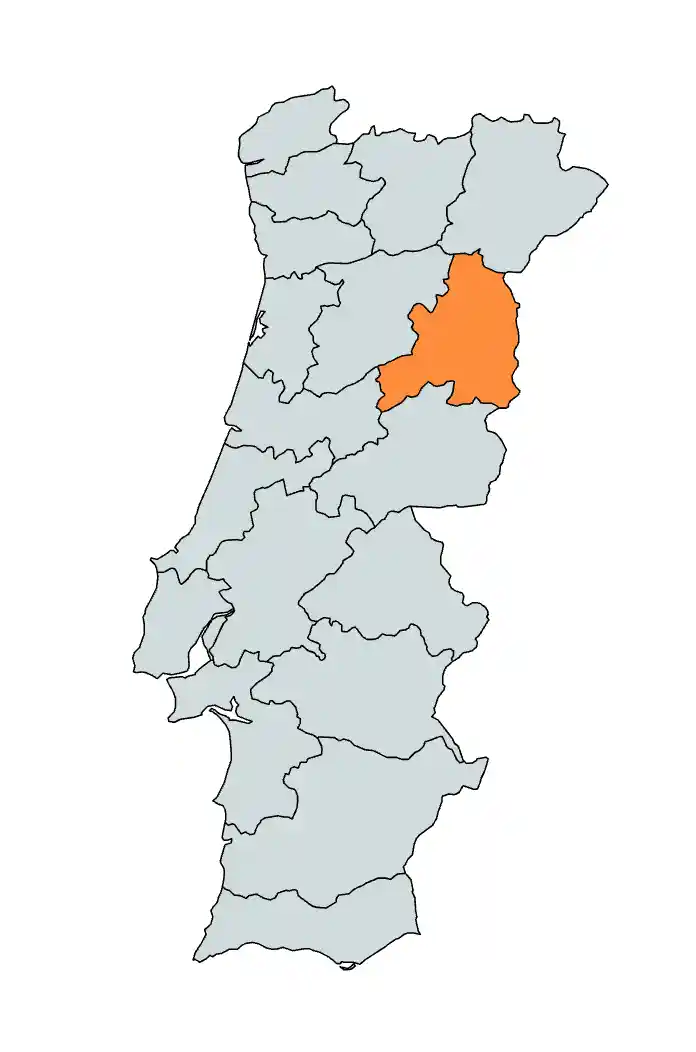
Guarda is the high heart of Portugal. It is a district of granite boulders and alpine air. This is where the country touches the sky in the Serra da Estrela. For a road trip, it offers dramatic mountain passes and silent stone villages. The roads twist through glacial valleys and climb toward jagged peaks.
Guarda city is the highest city in the country. The Cathedral looks like a fortress built from grey stone. Walk the medieval walls to feel the mountain wind. The streets are narrow and steep. They hide old quarters where secret marks are still carved into the doorways.
Continue into the mountains for the raw scenery. Navigate the hairpin turns of Vale Glaciário do Zêzere. It is a massive U-shaped valley carved by ancient ice. Reach Torre, the highest point in mainland Portugal. Even in spring, you might find patches of snow. Stop in Sabugueiro, the highest village, to buy local mountain cheese and wool capes.
Head to the edges for the Historical Villages. These are frontier strongholds. Sortelha is a village trapped in time. Its houses are built into the natural rock. Linhares da Beira is the capital of paragliding and medieval charm. To the north, the Côa Valley holds thousands of prehistoric carvings. Guarda district is the rocky backbone of the Portuguese north.
Guarda (district) highlights
- Torre Peak & Serra da Estrela Drive to the highest point in mainland Portugal to find a wind-whipped plateau where stone towers stand at exactly 1,993 meters. It is the only place in the country for winter skiing and offers year-round shops selling the famous, creamy Serra da Estrela mountain cheese.
- Sortelha Medieval Village Step into a granite time capsule where medieval houses are built directly into massive boulders and enclosed by perfectly preserved ring walls. The narrow alleys and castle ruins remain untouched by modern architecture, offering a silent, cinematic atmosphere for road trippers.
- Vale Glaciário do Zêzere Navigate the scenic N338 road through one of the largest glacial valleys in Europe, a massive U-shaped corridor carved by ancient ice. The drive offers dizzying views of steep granite cliffs and the tiny, distant shepherd huts dotting the valley floor below.
- Côa Valley Archaeological Park Explore the world’s largest outdoor gallery of Paleolithic art, where thousands of animal engravings were carved into schist rocks over 20,000 years ago. Guided 4x4 tours take you deep into the rugged river valley to see these prehistoric masterpieces under the open sky.
- Almeida Star Fortress Visit this remarkable frontier town surrounded by a 12-pointed star-shaped wall, one of the most sophisticated military defense systems in the world. Walk the underground casemates and massive ramparts that once protected the Portuguese border during the Napoleonic Wars.
- Castelo Rodrigo Climb to this hilltop "Historical Village" to see medieval ruins that overlook the vast plains stretching all the way into Spain. The village features manualine windows, a massive stone cistern, and local shops famous for honey-coated almonds and wild berry liqueurs.
- Poço do Inferno Waterfall Follow a winding forest road near Manteigas to find this "Hell’s Well," a dramatic waterfall that plunges into a crystal-clear emerald pool. Surrounded by dense woodland and towering rock formations, it is a hidden freshwater sanctuary perfect for a cooling mountain hike.
- Trancoso Jewish Quarter Discover the secret history of the Inquisition in this walled medieval town, where Hebrew inscriptions are still visible on granite doorframes. The town’s narrow streets lead to a robust castle and a network of hidden synagogues used by the region’s historic "Crypto-Jewish" community.
- Covão dos Conchos Hike from the Lagoa Comprida dam to see what looks like a surreal "sinkhole" in the middle of a mountain lake. This man-made funnel is a unique engineering feat that whisks water through a 1.5-kilometer tunnel, creating a hauntingly beautiful, waterfall-like vortex.
- Linhares da Beira Drive to the paragliding capital of Portugal, a stone village famous for its high-altitude winds and a castle that boasts unique Romanesque details. The village is a perfect mix of ancient history and adventure sports, with paths that lead directly into the high mountain wilderness.
The local Four
History of Guarda (district)
Guarda's district history is carved into the rocky soul of the Serra da Estrela where prehistoric shepherds once sheltered in glacial caves. Known as the Land of the Five F’s, this district was forged as a high altitude shield. For centuries its fortresses stood as the first line of defense against Spanish invaders and Napoleonic armies. This earned Guarda its reputation as the rugged guardian of the Portuguese border.
The soul of the district lives in the Historical Villages. In the 12th century King Sancho I founded the city of Guarda at 1,056 meters to watch the horizon. It became a melting pot of cultures. The narrow alleys of the Jewish Quarter still hide secret crosses carved into doorframes by families fleeing the Inquisition. Further north the Côa Valley tells an even deeper story. Thousands of Paleolithic animal engravings survive on the riverbanks. They prove that humans have found inspiration in these wild canyons for over 20,000 years.
You can walk the star shaped ramparts of Almeida or touch the boulder hewn walls of Sortelha. From the Romanesque ruins of Castelo Rodrigo to the high mountain traditions of wool and cheese in Manteigas history is everywhere. It is not kept in a museum. It lives in the wind that blows through the granite peaks.