

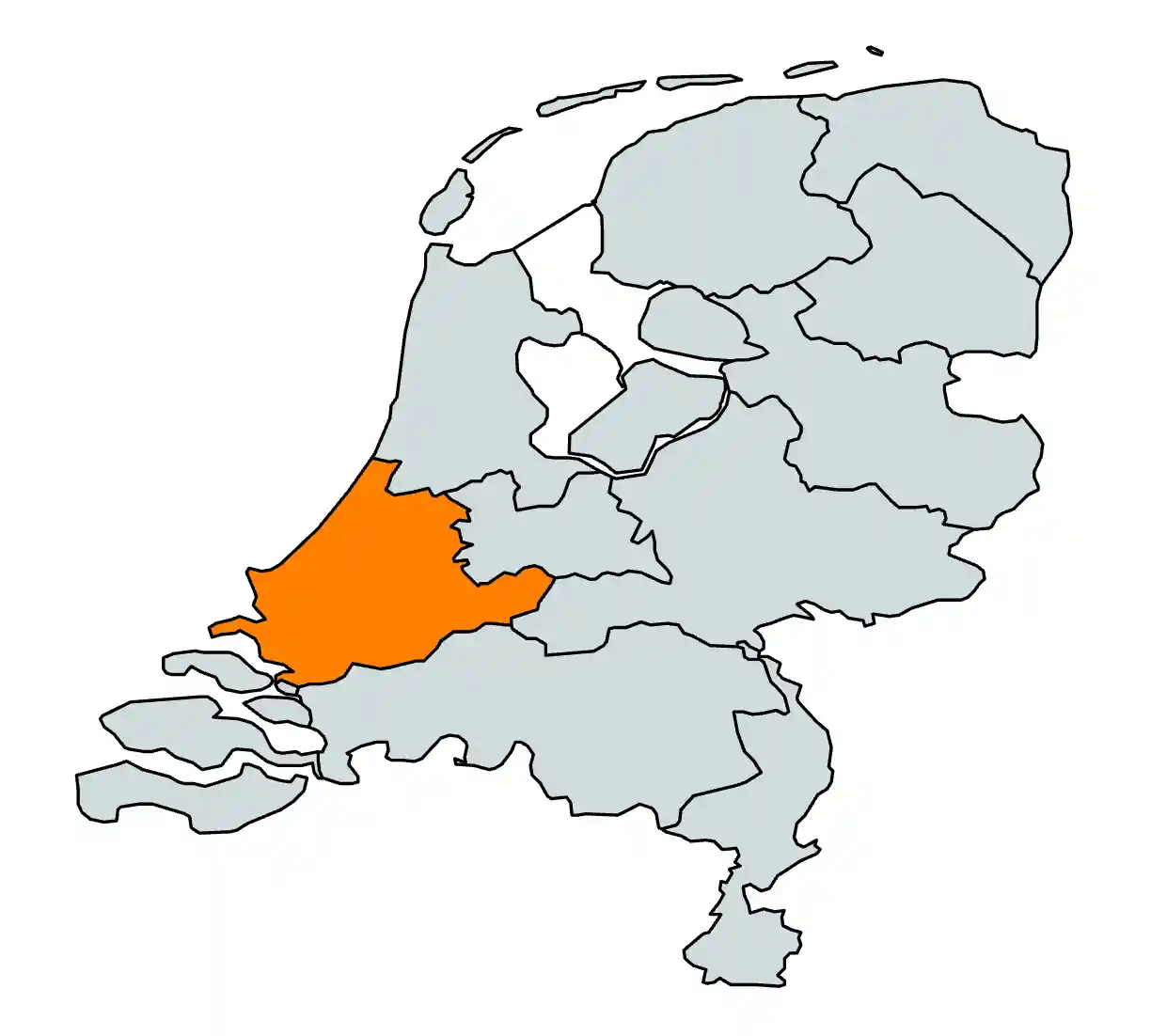
South Holland is home to The Hague, the political heart of the Netherlands, where royal palaces stand near the beaches and peaceful parks. Rotterdam adds a completely different energy with bold architecture, a major international harbor and a skyline that feels more global than Dutch.
Drive a little outside the cities and you’ll find classic Dutch scenery. Windmills turn above green fields in Kinderdijk, water canals trace towns like Delft and Leiden. Spring transforms the region into a sea of color with vast flower fields, while the North Sea coast offers long beaches, seaside boulevards and dunes perfect for walking or cycling.
South Holland is also a place of famous painters, innovative design and diverse cuisine. From seafood in Scheveningen to Indonesian dishes influenced by colonial history. Every town has its own rhythm, from the student buzz of Leiden to the calm village streets around Gouda, where its famous cheese making remains a proud tradition.
South Holland highlights
- The Hague & Scheveningen South Holland’s political and cultural heart mixes historic landmarks with coastal life. Visit the Binnenhof, the Peace Palace, and masterpieces at the Mauritshuis. Go to Scheveningen for a wide sandy beach, a beachfront promenade and the pier with its lookout tower.
- Rotterdam A city of bold architecture and creative energy. Explore the Cube Houses, Erasmus Bridge and the ultra-modern Markthal. Explore the rebuilt harbor district of Kop van Zuid, take a boat trip through Europe’s largest port and enjoy the incredible food scene.
- Kinderdijk Windmills One of the most iconic places for windmills in the Netherlands. The 19 historic windmills stand in a wide open polder landscape, offering one of the country’s most photogenic spots. You can walk or cycle along the canals and visit a working museum mill to see how water management shaped Dutch life.
- Delft Famous for its blue and white pottery, historic squares and the legacy of painter Johannes Vermeer. Visit the Royal Delft factory for traditional blue ceramics, climb the tower of the New Church for a great view and explore the old town with its charming cafes and markets.
- Keukenhof The world’s most famous flower garden. About seven million tulips and other flowers bloom in stunning patterns and colors. The gardens are at their best from late March to May. Even outside the park, the surrounding bulb fields offer beautiful cycling routes.
- Biesbosch park De Biesbosch is one of Europe’s last freshwater wetlands and a great place to explore by boat or kayak. You can spot beavers, explore the walking trails or join a guided tour to learn how people once lived and worked in this unique delta landscape.
The local Four
History of South Holland
The story begins in the early Middle Ages, when settlements grew on patches of higher ground surrounded by rivers and wetlands. Farmers, fishermen and merchants built dikes to protect their land, setting the foundations of a region that would become one of Europe’s most important hubs.
By the 13th century cities like Leiden, Delft and The Hague were rising in influence. The Hague developed into the political heart of the Netherlands when the Counts of Holland established their residence there. The Binnenhof still reflects those medieval origins and remains the center of Dutch government.
During the Dutch Golden Age in the 17th century, South Holland flourished. Leiden became a leading center of science and education with the founding of Leiden University in 1575. Delft produced artists like Johannes Vermeer and became famous for its blue pottery, which was exported across Europe.
Rotterdam rebuilt itself after the devastating 1940 bombardment and developed into the largest port in Europe, shaping international trade and maritime innovation. South Holland is a mix of historic cities, modern skylines, coastal landscapes and centuries of engineering.