

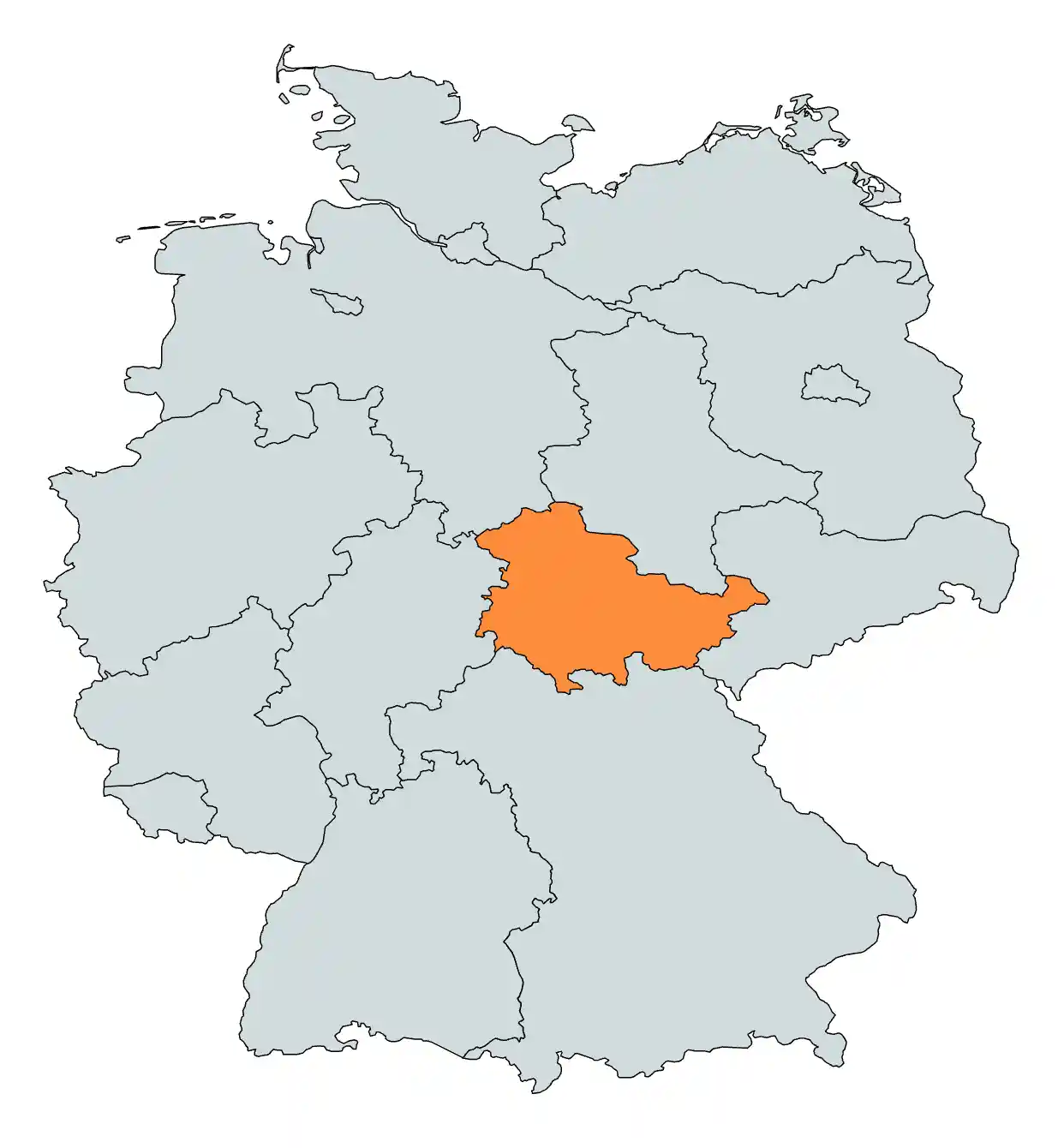
Thuringia truly is the Green Heart of Germany giving you a road trip that guides you through forests and intellectual history. This centrally located state is defined by the winding mountain roads of the Thuringian Forest contrasting sharply with its historic cultural grasslands. Driving here is an adventure that connects you instantly with nature and with the great thinkers of the past.
The state holds an extraordinary concentration of cultural significance. You can trace the footsteps of Martin Luther at the mighty Wartburg Castle. You can visit the birthplaces and working centers of poets like Goethe and Schiller in the beautiful city of Weimar. This region served as the wellspring for German Classicism the Reformation and the musical genius of Bach.
The atmosphere in Thuringia is one of wisdom and deep historical resonance. You can spend the morning hiking a remote forest path and the afternoon exploring a Baroque palace or a museum dedicated to a great composer. This region rewards the curious road tripper with beautiful scenery and a powerful sense of having toured the very core of German intellectual history.
Thuringia highlights
- Wartburg Castle in Eisenach Where Martin Luther translated the New Testament into German. The castle rises above forested hills and has beautiful views, richly furnished halls and a deep sense of historic significance.
- Bach House Eisenach Pay homage to Johann Sebastian Bach at his birthplace museum in Eisenach exploring his life and the rich musical heritage of Thuringia.
- Erfurt Old Town and Domplatz Erfurt’s cathedral square is one of Germany’s most beautiful. The towering St. Mary’s Cathedral and St. Severus Church dominate a charming old town filled with medieval houses, cozy cafes and one of Europe’s oldest university sites.
- Weimar Birthplace of the Bauhaus movement and home to Goethe and Schiller. Explore elegant palaces, literary museums and parks that shaped some of Europe's most influential cultural movements.
- Thuringian Forest and Rennsteig Trail The region’s legendary ridgeway trail runs through dense pine forests and hills. You’ll find scenic lookouts, charming villages and traditional mountain inns.
- Hainich National Park Germany’s largest hardwood forest and a biosphere reserve. Walk the canopy trail high above ancient beech trees and enjoy peaceful routes through untouched woodland.
- Kyffhäuser Monument This colossal hillside monument honors Emperor Barbarossa and Wilhelm I. The panoramic viewpoint reveals endless landscapes and the surrounding Kyffhäuser hills are ideal for scenic drives and hikes.
The local Four
History of Thuringia
The history of Thuringia is inseparable from the people who shaped German thought and culture. In the Middle Ages the region was centered around the mighty Landgraviate of Thuringia a powerful territory that gave rise to many smaller principalities. The region's dense central location and vast forests earned it the nickname the "Green Heart of Germany". A geographic feature that protected its independence for centuries.
The 16th and 18th centuries saw Thuringia become the intellectual powerhouse of the German world. It was at Wartburg Castle that Martin Luther translated the New Testament an act that ignited the Reformation. Later the small court city of Weimar became the center of German Classicism drawing giants like Goethe and Schiller who shaped modern literature. Throughout this time figures like Johann Sebastian Bach enriched the region with unparalleled musical heritage in towns across the state.
The 19th century brought fragmentation and then industrial growth before the entire region was unified into the state of Thuringia in 1920. Today the region preserves its profound historical legacy with pride giving travelers a unique experience. Driving here means following the path of philosophers, composers and reformers. A journey through the true core of German intellectual identity.