

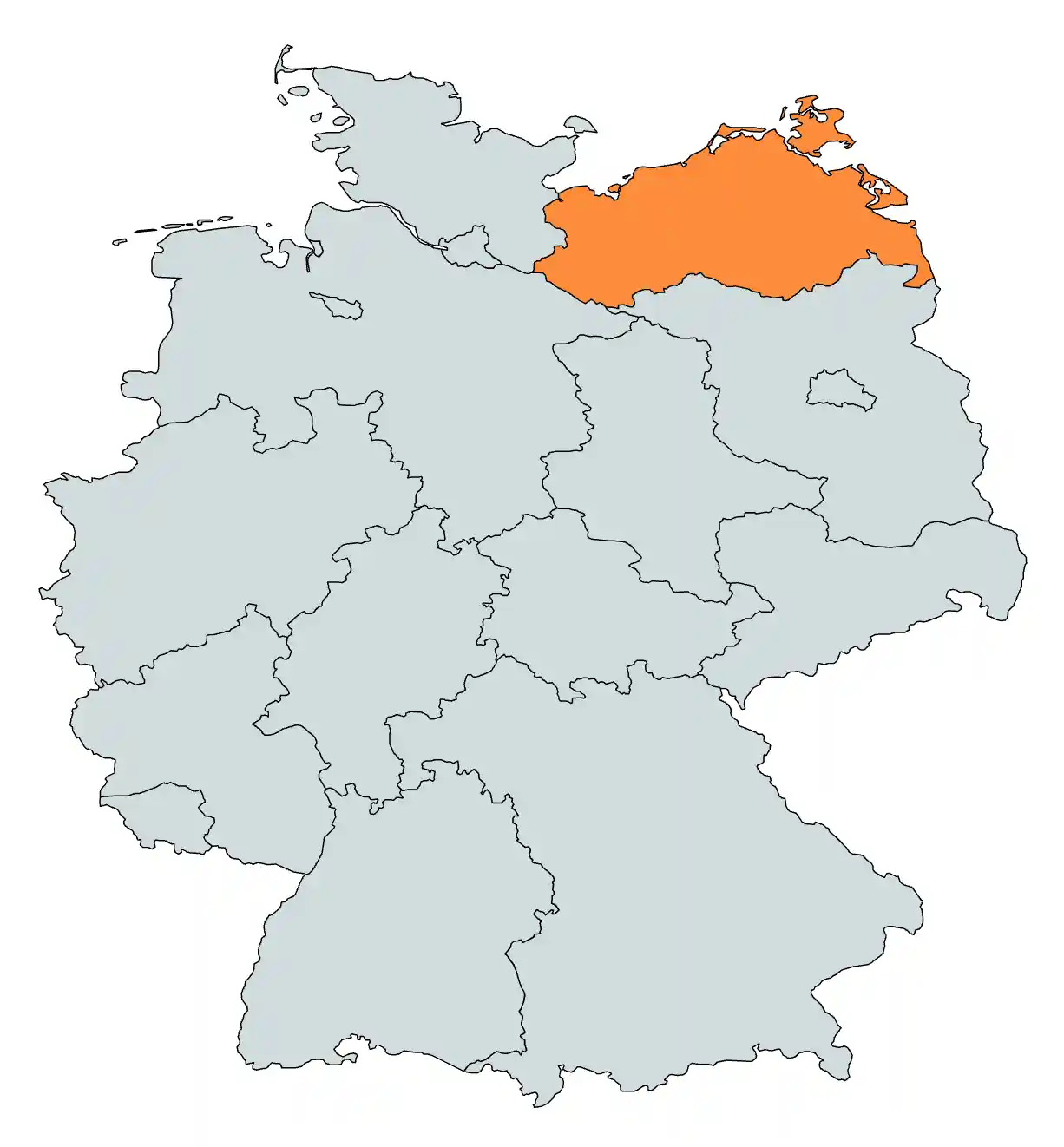
For a completely different side of Germany, head north to Mecklenburg-Vorpommern. This region is defined by endless horizons, glittering water and a sense of freedom. This is the "Land of a Thousand Lakes" and the gateway to the Baltic Sea. The road often feels like it is floating between the water and the sky. Instead of tight mountain hairpins, you will find yourself cruising down the famous Alleen. These are picturesque country roads lined with tunnels of ancient oak and chestnut trees.
The route here is a journey through maritime history and island life. You can cross impressive bridges to reach Germany’s largest islands, Rügen and Usedom, where dramatic chalk cliffs tower over white sandy beaches. The driving is relaxed and scenic, punctuated by stops in Hanseatic cities like Stralsund and Wismar. You'll encounter massive red-brick Gothic cathedrals dominate the skyline.
The vibe in the northeast is refreshingly laid-back. It is the kind of place where you park by a harbor to eat a fresh Fischbrötchen (fish sandwich) right off a boat, watching the waves roll in. Mecklenburg-Vorpommern gives you a spacious tranquil escape.
Mecklenburg-Vorpommern highlights
- Schwerin Castle Often called the Neuschwanstein of the North. Schwerin Castle rises from an island on Lake Schwerin with golden towers, lavish rooms and landscaped gardens. The surrounding old town makes it even more magical.
- Rügen’s Chalk Cliffs (Königsstuhl) Germany’s most dramatic coastline. Walk through Jasmund National Park’s beech forests before reaching the white cliffs dropping straight into turquoise Baltic waters.
- Hiddensee Island A car free island where time slows down. Expect dune landscapes, long quiet beaches, lighthouses, thatched houses, and pure tranquillity. Perfect for cycling or walking.
- Wismar Old Town A beautifully preserved Hanseatic city with one of the biggest market squares in northern Germany, brick Gothic churches and a pretty harbor. Don’t miss the Wasserkunst fountain and Alter Hafen.
- Cape Arkona A rugged cliff cape on Rügen with two historic lighthouses that provide sweeping views of the Baltic and remnants of a Slavic fort. Fantastic for photography and coastal hikes.
The local Four
History of Mecklenburg-Vorpommern
The history of Mecklenburg-Vorpommern is the story of two neighbors: Mecklenburg to the west and Western Pomerania (Vorpommern) to the east. They were eventually brought together by war and politics. Both regions shared a golden age during the medieval Hanseatic League. Cities like Rostock, Wismar and Stralsund grew immensely rich and powerful through maritime trade.
A unique chapter in the region’s history is its strong Scandinavian connection. Following the Thirty Years' War in 1648, large parts of Western Pomerania and the city of Wismar fell under Swedish rule. You can still see traces of this era today in the architecture and the "Schwedenfest" celebrations in Wismar. It wasn’t until 1815 that Prussia finally secured control over the coast, bringing the region fully under German control.
Since reunification in 1990, Mecklenburg Vorpommern has reinvented itself as one of Germany’s most scenic and peaceful regions. Known for protected coastlines, historic spa towns, national parks and restored Hanseatic cities like Wismar.